When a token surges from a $100,000 market cap to $7.5 million in four days, the crypto community pays attention. That is exactly what happened with vwa crypto in early October 2025, when this Solana-based token exploded onto decentralized exchanges, generated over $1 million in daily trading volume, and sparked a debate that has not fully settled since.
On one side: traders drawn to its RWA narrative and early price momentum. On the other: analysts pointing to insider concentration, unverifiable claims, and a marketing playbook that mirrors previous speculative launches. Understanding vwa crypto requires separating what the project claims from what blockchain data and independent verification actually confirm.
| 🔍 Topic | 📌 Key information |
|---|---|
| 📛 Full name | Vanguard RWA (ticker: VWA) |
| ⛓️ Blockchain | Solana |
| 📅 Launch date | October 1, 2025 |
| 🏔️ Peak market cap | ~$7.5–$7.76 million (October 2025) |
| 💲 Current price range | ~$0.0002–$0.0004 (as of May 2026) |
| 📊 Circulating supply | ~999.86 million to 1 billion VWA |
| ⚠️ Insider concentration | Top 50 wallets hold approximately 90% of supply |
| 🏦 Claimed affiliation | Vanguard Group and Ripple — both officially deny any association |
| 🛒 Where to trade | Jupiter DEX on Solana; available via Coinbase DEX interface and Phantom wallet |
| 🚨 Key risks | No whitepaper, no verified team, no audit, extreme wallet concentration |
What vwa crypto claims to be and how it was marketed ?
Vwa crypto presents itself as a Real World Asset (RWA) platform built on the Solana blockchain, with the stated mission of tokenizing precious metals and gemstones including gold and silver. The RWA narrative is well-timed: the tokenization of physical assets has become one of the most discussed themes in blockchain finance, with major institutions actively exploring frameworks for bringing commodities, real estate, and securities on-chain. By positioning itself within this trend, vwa crypto attempted to benefit from the credibility that legitimate RWA projects have been building.
The token’s ticker, VWA, was chosen to evoke associations with both Vanguard Group, one of the world’s largest traditional asset managers, and the broader RWA sector. Its official branding as “Vanguard RWA” amplified this impression considerably. The problem is that neither Vanguard Group nor Ripple, both of which were prominently cited in early VWA marketing materials, has any confirmed relationship with this project. Ripple has not mentioned VWA in any press release, developer update, or social communication. Vanguard Group, despite its name appearing throughout VWA marketing, has made no acknowledgment of the token’s existence. The claimed partnerships are unsubstantiated.
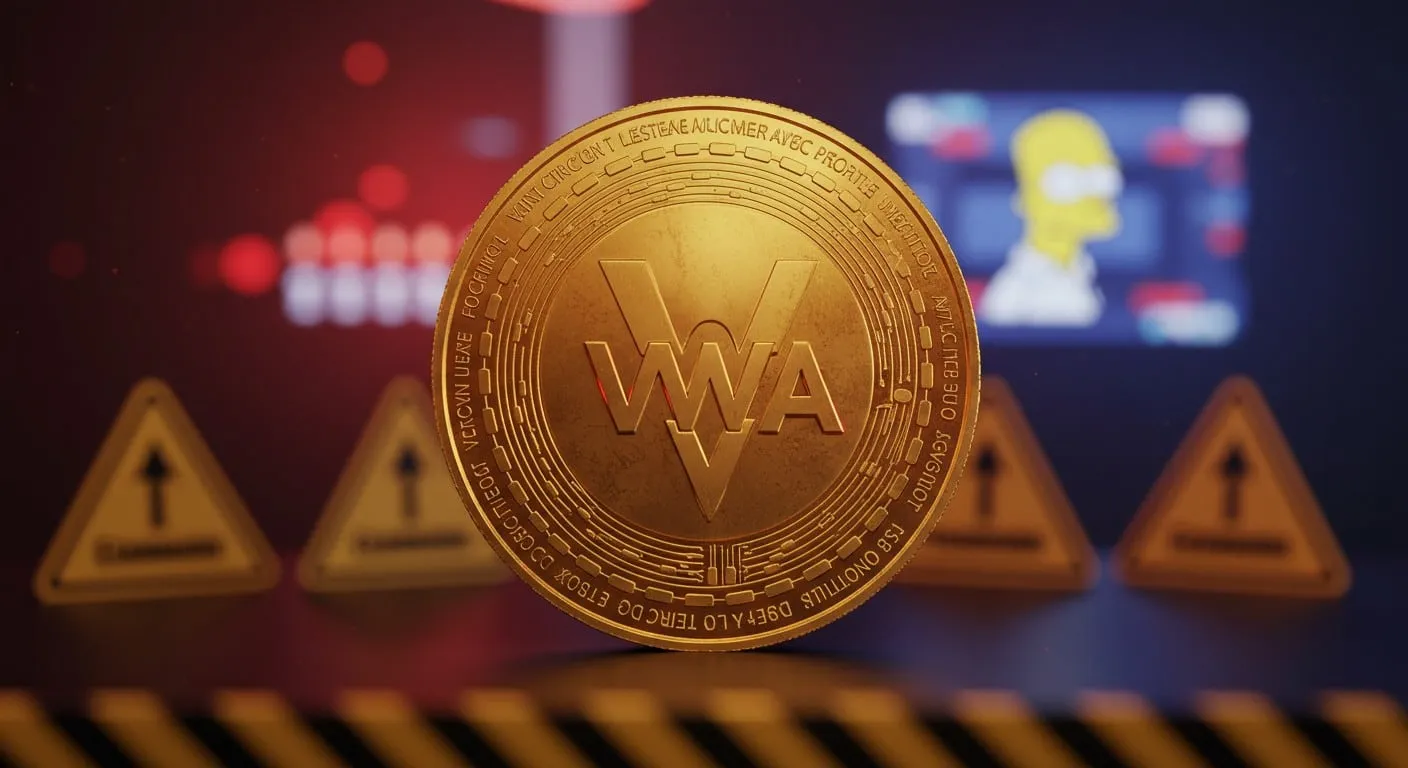
The viral marketing campaign that surrounded VWA’s launch included fabricated screenshots purporting to show that the animated television program The Simpsons had predicted the token’s rise. These images were confirmed to be digitally altered — the original frames do not contain any VWA reference. This tactic, using manipulated pop culture references to generate artificial buzz, is a recognized pattern in speculative token launches and one that informed investors treat as an automatic warning signal.
Vwa crypto on-chain data: what the numbers actually show
Whatever narrative surrounds a cryptocurrency project, the blockchain is a source of objective data that marketing cannot alter. The on-chain profile of vwa crypto raises several concerns that any investor should examine before making a decision.
Supply concentration is the most pressing structural issue. Analysis using Bubble Maps, a blockchain analytics tool that maps token distribution and wallet relationships, found that the top 50 wallet addresses hold approximately 80% to 90% of the total VWA supply. Many of these wallets are linked to the smart contract address itself, suggesting a small group of insiders controls the vast majority of circulating tokens. When such a high proportion of supply is concentrated in a small number of wallets, those holders can exert enormous influence over price movements, and any coordinated exit from even a fraction of those positions would generate severe selling pressure on remaining holders.
The price history since launch illustrates this dynamic clearly. VWA launched on October 1, 2025 and reached its peak price of approximately $0.0075 within days, driving the market cap to around $7.5 to $7.76 million. The rally was accompanied by over $1 million in daily trading volume on platforms like Jupiter DEX. Then came the correction: by December 2025, the price had fallen to approximately $0.0016, and by early 2026 it had declined further to the $0.0002 to $0.0004 range, representing a decline of roughly 95% or more from its peak.
| 📅 Date | 💲 VWA price | 📊 Market cap | 📋 Notable event |
|---|---|---|---|
| October 1, 2025 | Near zero | ~$100,000 | Token launch on Solana |
| October 5–8, 2025 | ~$0.0075 | ~$7.5–7.76 million | Peak after viral marketing campaign |
| December 2025 | ~$0.0016 | ~$1.6 million | Sharp correction; moderate liquidity |
| February–March 2026 | ~$0.0003–$0.0004 | Below $1 million | Ongoing price decline |
| May 2026 | ~$0.0002–$0.0004 | Very low | Current trading range on DEXs |
The trading volume figures from the peak period, while numerically impressive, need context. Daily volumes exceeding $1 million on a token with a $7 million market cap imply very high turnover driven primarily by speculative trading rather than genuine utility or long-term accumulation. This pattern, rapid price increases followed by substantial corrections exceeding 50% of peak values, is one that analysts associate with coordinated buying and subsequent distribution by insiders, though it does not by itself constitute proof of manipulation.
READ ALSO : Crypto bill: what the CLARITY Act means for your digital assets right now
How to buy and store vwa crypto: the practical mechanics
For those who have decided to engage with vwa crypto despite its risk profile, the practical access points are limited compared to established tokens. VWA is not listed on major centralized exchanges. It trades exclusively on decentralized platforms, primarily on Solana-based DEXs.
The most commonly used method is the Jupiter DEX on Solana, which aggregates liquidity across Solana-based pools and provides the SOL/VWA trading pair. Coinbase also provides access through its DEX interface, allowing users to buy VWA using USDC or other available funds via a DEX trade on the Solana, Base, or Ethereum networks. The Phantom wallet supports VWA directly, showing live price data and allowing trades within the app.
The purchasing process via Coinbase for first-time DEX users involves the following steps:
- Create a Coinbase account, complete identity verification, and fund the account via debit card, bank transfer, or existing crypto balance
- Search for VWA in the asset finder; the “DEX” tag above the chart indicates exclusive decentralized exchange availability
- Select “Buy and Sell,” choose USDC or available USD funds as the payment currency, review the amount and fees carefully, and execute the DEX trade
- Monitor the transaction; once confirmed on-chain, the VWA balance appears in your Coinbase portfolio and can be managed or transferred to a self-custody wallet like Phantom
Fees for VWA trades depend on the Solana network fee structure at the time of the transaction, which is generally very low due to Solana’s architecture. A 1% transaction fee applies to swaps on the Coinbase DEX interface. Storage options include the Phantom wallet, which is the dominant Solana-native wallet and supports VWA natively, as well as any wallet that supports Solana SPL tokens and the specific token contract address.
The single most important security step before any VWA trade is verifying the exact contract address against confirmed listings on CoinMarketCap, CoinGecko, or CryptoRank to ensure you are trading the correct token and not an imitation deployed on the same chain.
The RWA sector context: what legitimate projects look like by comparison
Understanding vwa crypto requires situating it within the broader Real World Asset tokenization sector, which is a genuine and rapidly growing area of blockchain finance. BlackRock, Franklin Templeton, Ondo Finance, and several other major institutions have launched tokenized fund products representing treasury bills, money market funds, and other traditional financial instruments. The on-chain RWA market has grown to tens of billions of dollars in total value locked, with institutional-grade custody, audit, and compliance infrastructure underpinning each product.
What distinguishes these legitimate RWA projects from vwa crypto is a set of concrete characteristics:
- Published documentation: genuine RWA platforms provide whitepapers, legal opinions, custodian agreements, and audit reports that verify the existence and management of the underlying physical or financial assets
- Verified team and legal entity: institutional-grade projects disclose their team identities, corporate structure, and regulatory status; anonymous teams with no verifiable history represent a fundamental accountability gap
- Third-party custody: tokenized gold, silver, or other commodities require a named custodian holding verifiable reserves; without this, the claim of asset-backing cannot be independently confirmed
VWA has none of these elements as of May 2026. The project’s website presents the RWA tokenization narrative without providing documentation of what assets are actually being held, who holds them, or how the tokenization mechanism operates. Claiming to tokenize precious metals is substantively meaningless without verified custody arrangements, regular attestations, and an identifiable legal structure.
The investor verdict: what the vwa crypto data tells you
Taken together, the picture that emerges from vwa crypto is one of a project with a compelling narrative, effective early-stage viral marketing, and structural characteristics that match well-documented risk patterns rather than legitimate RWA infrastructure.
The 90% insider concentration presents the most concrete risk: any significant movement from those wallets would cascade through a relatively shallow liquidity pool and produce dramatic price declines for remaining holders. The absence of a whitepaper, audit, verified team, or custody documentation means there is no independent basis for evaluating whether the project’s RWA claims have any substance. The price decline of approximately 95% from peak to current levels reflects the outcome that these structural characteristics typically produce.
READ ALSO : Cryptocurrency crash: what caused the 2025 collapse and where markets stand in 2026
For investors drawn to the Real World Asset sector as a legitimate crypto thesis, the more defensible approach is to evaluate projects with verified institutional backing, transparent custody arrangements, and publicly disclosed team and legal structures. The RWA narrative that vwa crypto borrowed has real merit as a macro investment theme — but the merit of the theme does not transfer to every project that uses its language.